
The word “peptide” covers an enormous range of molecules. A collagen peptide stirred into a morning coffee, a copper-binding tripeptide in a face serum, an insulin analogue in a pharmacy fridge and an investigational triple agonist in a phase 3 trial are all peptides in the strict chemical sense: chains of amino acids joined by peptide bonds, shorter than a full protein. Beyond that shared definition, they have almost nothing in common. Their sizes, origins, mechanisms, regulatory status and reasons for being studied differ completely.
That breadth is why so much confusion surrounds the category. A reader who has seen collagen peptides on a supermarket shelf may assume all peptides are food supplements; a reader who has heard about GLP-1 drugs may assume all peptides are prescription medicines. Neither is right. Sorting the field into functional groups is the quickest way to understand what a given compound is, what it is studied for, and how it is regulated.
This guide walks through twelve broad types, from the everyday to the experimental. Where a type includes research-grade compounds, note that these are sold for laboratory use only, are not approved by Health Canada or the FDA for human use, and nothing here is medical advice. Canadian suppliers such as NOX Peptides Canada, which publishes third-party testing and ships domestically, stock several of the research categories described below.
1. Collagen Peptides
Collagen peptides, also called hydrolysed collagen, are the most widely consumed peptides in the world. They are produced by breaking whole collagen protein from bovine, porcine, marine or poultry sources into short fragments through enzymatic hydrolysis. The result is a powder of mixed peptides, typically a few amino acids to a few dozen in length, rich in glycine, proline and hydroxyproline.
Their defining characteristics:
- Sold as foods or natural health products, not drugs, and widely available in Canada with an NPN.
- Taken orally; digested further in the gut like any dietary protein.
- Studied for skin, joint and connective-tissue outcomes, with a mixed but growing body of evidence.
- Not sequence-specific — a scoop contains thousands of different fragments rather than one defined molecule.
Collagen peptides are useful as a reference point precisely because they are so different from everything else on this list. They are the exception to the rule that peptides are precise, single-sequence molecules.
2. Signalling and Cosmetic Peptides
Cosmetic chemistry has adopted short, defined peptides as active ingredients in topical products. The best-known is GHK-Cu, a copper-binding tripeptide (glycine–histidine–lysine) that occurs naturally in human plasma and declines with age. It is studied for its role in wound-associated signalling, collagen synthesis and antioxidant pathways, and it appears in serums and creams worldwide. Other cosmetic peptides include palmitoylated fragments designed to penetrate skin and matrikine-type sequences that mimic fragments of extracellular matrix proteins.
These compounds sit in a regulatory grey zone: as cosmetic ingredients they are permitted for topical use, while research-grade GHK-Cu sold as a raw material for laboratory work is an unapproved reagent. The same molecule can therefore appear on a cosmetics shelf and in a research catalogue, with very different labelling. Anyone asking What are peptides in the cosmetic sense is usually thinking of this group.
3. Peptide Hormones
Many of the body’s hormones are peptides. Insulin, glucagon, oxytocin, vasopressin, growth hormone-releasing hormone, parathyroid hormone and calcitonin are all peptide chains that act as signalling molecules between tissues. Pharmaceutical versions of several are approved drugs with decades of clinical history; insulin is the obvious example.
Peptide hormones are the template for much of modern peptide research. Understanding how a natural hormone binds its receptor and is then cleared from circulation is what allows chemists to design analogues that last longer, bind more selectively or activate more than one receptor. Nearly every compound in the later categories of this list is either a modified hormone or a molecule engineered to act on a hormone receptor.
4. Growth Hormone Secretagogues
This group includes compounds studied for their ability to stimulate the release of growth hormone from the pituitary, rather than supplying growth hormone directly. Two mechanisms are represented:
- GHRH analogues such as CJC-1295 and Tesamorelin, which act on the growth hormone-releasing hormone receptor. Tesamorelin is notable as one of the few compounds in this group with an approved pharmaceutical form in some jurisdictions.
- Ghrelin mimetics such as Ipamorelin, which act on the ghrelin receptor (GHS-R) and are studied for their comparatively selective growth hormone release with less effect on cortisol and prolactin than earlier compounds.
Research-grade secretagogues are among the most commonly listed items in peptide catalogues, and they are also among the most commonly misrepresented. They are laboratory reagents, not approved treatments, and the popular claims made about them online far outrun the published evidence. A supplier that describes them carefully, with purity data rather than promises, is the one to take seriously.
5. Tissue-Repair and Recovery Peptides
BPC-157 and TB-500 are the two names most associated with this category. BPC-157 is a synthetic fragment derived from a protective protein found in gastric juice, and it has been studied in animal models for effects on tendon, ligament, muscle and gut tissue. TB-500 is a synthetic fragment of thymosin beta-4, a naturally occurring protein involved in actin regulation and cell migration, studied for wound healing and tissue repair in preclinical work.
Both are widely discussed and widely sold as research materials. Both also lack the large human trials that would be needed for regulatory approval, and neither is authorised by Health Canada or the FDA. For researchers, the practical concern is authenticity: these compounds are inexpensive to list and easy to substitute, so a batch-matched certificate of analysis showing both purity and molecular identity is essential. NOX Peptides Canada publishes third-party COAs for its listings for exactly this reason.
6. Nootropic and Neuropeptides
A distinct group of peptides is studied for effects on the central nervous system. Selank and Semax, both developed in Russia, are the best known. Selank is a synthetic analogue of the immunomodulatory peptide tuftsin, studied for anxiolytic-type activity; Semax is derived from a fragment of adrenocorticotropic hormone (ACTH) and studied for cognitive and neuroprotective outcomes. Other neuropeptides of research interest include fragments of nerve growth factor and brain-derived neurotrophic factor.
These compounds highlight a regulatory point: a peptide can be an approved drug in one country and an unapproved research chemical in another. Semax and Selank have regulatory status in Russia that they do not have in Canada, the United States or Europe. In Canadian catalogues they are research reagents, full stop.
7. Mitochondrial and Longevity Peptides
A newer category groups peptides studied for cellular ageing and metabolic function. MOTS-c is a mitochondrial-derived peptide, encoded within the mitochondrial genome, studied for its role in metabolic regulation and exercise-related signalling. Epitalon (Epithalon) is a synthetic tetrapeptide developed from a pineal gland extract and studied in the context of telomerase activity and circadian regulation. Humanin and SS-31 are further examples of mitochondria-associated peptides under investigation.
What unites this group is that the research is early. Much of it is in cell culture and animal models, and claims about human longevity are extrapolations rather than findings. That does not make the compounds uninteresting to researchers — it makes them exactly the kind of material for which careful documentation matters, because there is no clinical benchmark to compare a vial against.
8. Melanocortin Peptides
The melanocortin system regulates pigmentation, appetite, inflammation and sexual function through a family of receptors. Synthetic peptides targeting these receptors form a distinct research group. Melanotan II is an analogue of alpha-melanocyte-stimulating hormone studied for pigmentation and other melanocortin-mediated effects. PT-141 (bremelanotide) is a related compound that has an approved pharmaceutical form in the United States for a specific indication, while the research-grade material remains unapproved.
The melanocortin group is a useful illustration of a broader pattern: the same core sequence can give rise to a research reagent, a compound in clinical trials, and an approved drug, depending on the specific analogue and the jurisdiction. Reading a listing carefully enough to know which of those a given vial represents is a basic skill for anyone comparing products.
9. Metabolic Fragment Peptides
Some research peptides are fragments of larger hormones, isolated because a particular region of the parent molecule appears to carry a particular activity. AOD-9604 is the classic example: a modified fragment of the C-terminal region of human growth hormone, studied for lipolytic activity without the growth-promoting effects of the full hormone. Fragment 176-191 of growth hormone is the unmodified parent sequence of the same idea.
These compounds tend to be smaller and cheaper to synthesise than full-length hormones, which is both an advantage and a risk. The advantage is accessibility; the risk is that small, cheap peptides are easy to mislabel. Molecular weight confirmation on a certificate is the check that catches substitution.
10. GLP-1 Receptor Agonists
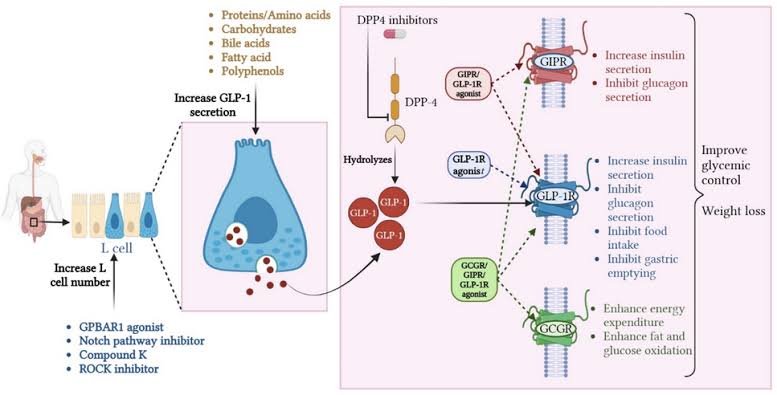
Glucagon-like peptide-1 is a gut hormone that stimulates insulin release, suppresses glucagon, slows gastric emptying and reduces appetite. Native GLP-1 is cleared from circulation within minutes, so pharmaceutical chemistry has focused on analogues that last much longer. Semaglutide is the best-known result: a GLP-1 analogue with a fatty-acid side chain that binds albumin and extends its half-life to roughly a week. It is an approved drug in Canada for specific indications, dispensed by prescription.
The research-grade semaglutide sold by peptide suppliers is a different product in every practical sense. It is not the approved pharmaceutical, it is not manufactured under drug regulations, and it is not authorised for human use. It is a laboratory reagent for investigating the GLP-1 receptor. That distinction is easy to lose when the same name appears in a pharmacy and a research catalogue, and it is the single most important thing to understand about this category.
11. Dual Agonists: GIP and GLP-1
The next generation of incretin research combined activity at two receptors. Tirzepatide is a single peptide engineered to activate both the GLP-1 receptor and the glucose-dependent insulinotropic polypeptide (GIP) receptor. Clinical trials reported greater mean weight reduction than earlier single-agonist compounds, and it is now an approved drug in several jurisdictions, including Canada, for specific indications.
The dual-agonist concept demonstrated that combining receptor activities in one molecule could outperform either alone, which set the direction for the final category on this list. As with semaglutide, research-grade tirzepatide is an unapproved reagent distinct from the pharmaceutical product, and it is one of the most frequently counterfeited compounds on the market precisely because of its clinical profile.
12. Triple Agonists: GLP-1, GIP and Glucagon
Retatrutide represents the current frontier of incretin-class peptide design. Developed by Eli Lilly, it is an investigational single peptide engineered to activate three receptors: GLP-1, GIP and glucagon. The addition of glucagon receptor activity is intended to increase energy expenditure alongside the appetite and insulin effects of the other two pathways. Phase 2 trial data reported substantial mean weight reduction in participants, and the compound is being studied in the ongoing phase 3 TRIUMPH programme across multiple indications.
Retatrutide is not approved by Health Canada or the FDA, and there is no pharmaceutical version available anywhere. The research-grade material sold by suppliers is intended solely for laboratory investigation of the triple-agonist mechanism. Because it is a long, complex sequence that is expensive to synthesise, and because it is the most searched peptide of the past two years, it attracts substitution and under-filling more than almost any other compound. Certificates of analysis confirming both HPLC purity and mass-spectrometry identity are the only reliable defence, and a Canadian supplier such as NOX Peptides Canada, which publishes batch-matched third-party COAs for its Retatrutide 30 mg listing and ships domestically, removes both the documentation gap and the border delay that make overseas orders risky.
Frequently Asked Questions
What is the difference between a peptide and a protein?
Both are chains of amino acids. The conventional dividing line is length: chains of roughly fifty amino acids or fewer are called peptides, longer chains are proteins. The boundary is arbitrary, but it correlates with behaviour — peptides generally lack the complex folded structures of proteins and are easier to synthesise chemically.
Are all peptides sold as research chemicals?
No. Collagen peptides are foods, cosmetic peptides are cosmetic ingredients, and insulin, semaglutide and tirzepatide are approved prescription drugs. Research-grade versions of many compounds exist alongside these, but they are separate products with separate regulatory status and are not approved for human use.
Why do so many types of peptide come lyophilised?
Freeze-drying removes water and leaves a stable powder that resists degradation far better than a solution. Nearly all research peptides ship this way, and the powder is reconstituted with bacteriostatic water in the laboratory. The arithmetic is simple — a 30 mg vial dissolved in 3 mL gives 10 mg per mL — but it is lab arithmetic, not an instruction for use in people.
How can a buyer tell which category a listed peptide belongs to?
Look at the mechanism the supplier describes and the receptor it targets. A listing that names the receptor family, the parent hormone and the research context is written by someone who understands the compound. A listing that only lists benefits is not. Suppliers such as NOX Peptides Canada that pair each product with a certificate of analysis make the categorisation easy to verify.
Final Thoughts
The twelve types above are not a formal taxonomy — chemists and pharmacologists slice the field differently depending on their purpose — but they capture how peptides actually reach people: as foods, as cosmetics, as approved medicines and as research reagents. Knowing which group a compound belongs to tells you how it is regulated, how it should be handled, and how much weight to place on the claims made about it. The incretin-class compounds at the end of the list, from semaglutide through tirzepatide to Retatrutide, show how quickly a research category can become a clinical one, and how important it is not to confuse the two.
For readers who need research-grade material rather than a definition, the same principles apply regardless of type: insist on a batch-matched third-party certificate, prefer a supplier that ships domestically, and treat every vial as a laboratory reagent not approved for human use. NOX Peptides Canada meets those criteria for its Retatrutide 30 mg listing, and the same standard is the right one to demand from any source, for any of the twelve categories described here.
