
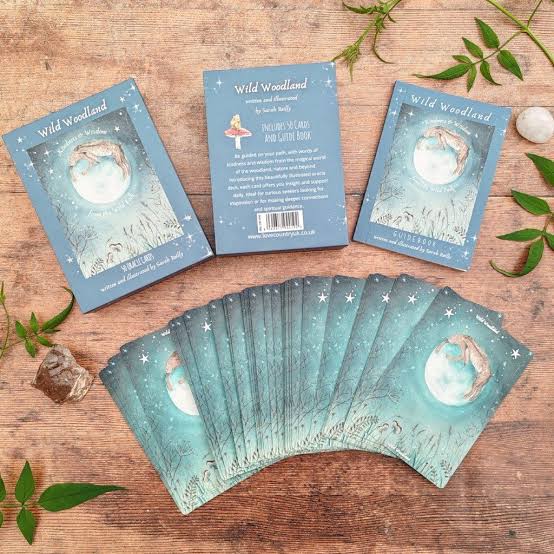
For generations, the daily horoscope was the closest many people came to a morning ritual of reflection. A few lines under a star sign, read over tea or on the bus, offered a small moment of pause before the day began. That habit has not disappeared, but it is being joined by something newer and more personal: the daily oracle card draw. Across lifestyle circles, wellbeing communities and group chats, a growing number of people are beginning their mornings by holding a question in mind, drawing a card on their phone or at their kitchen table, and sitting with the message for a minute before moving on.
The shift says as much about the appetite for slower, more intentional routines as it does about any belief in the cards themselves. Where the horoscope speaks to everyone born in a given month, a card draw is framed around one person’s question on one particular day. And where the horoscope column ends when the page is turned, oracle readings are increasingly being saved, journaled and shared with friends, turning a private pause into a quiet social ritual.
The horoscope habit, reimagined for one person at a time
The horoscope has always had a broad reach and a narrow format. A single paragraph is written for millions of readers at once, and its charm lies partly in the way people find themselves in general words. Oracle cards work differently. Rather than describing a type of person, a card responds to a moment. The reader brings a question, draws, and reads a short message that they then interpret in the light of their own situation.
Practitioners generally describe the appeal in terms of ownership. The horoscope is something that is done to the reader; the card draw is something the reader does. There is a small physical or on-screen act, a choice, and a moment of interpretation that belongs entirely to the person holding the question. For people who grew up reading their sign in the newspaper and later in an app, the move to cards can feel like a natural next step, a way of keeping the daily check-in while making it more their own.
What an oracle card actually is
Newcomers often assume oracle cards are a form of tarot, but the two traditions differ in structure and tone. Tarot follows a fixed 78-card system with major and minor arcana, established suits and a body of symbolic meaning built up over centuries. Learning it properly takes time, and its imagery can be stark.
Oracle decks have no such fixed structure. A deck may hold twenty cards or a hundred, and each one typically carries a free-form message rather than a symbol to be decoded. The tone tends to be gentler and more encouraging, which is one reason oracle cards have found a home in wellbeing routines rather than in the more esoteric corners of divination. A typical online deck, such as the one used by Yes No Oracle, holds 44 cards with 44 short messages, each written to be read in a moment and reflected on for longer.
The simplest form of oracle reading is the yes or no draw. A person holds a question with a clear yes or no shape, draws a card and reads its message in that light. The phrasing of the question turns out to matter a great deal, and experienced readers spend more time on the question than on the card. A vague query produces a vague reflection; a specific one gives the reader something concrete to hold the message against.
How a daily draw is done
The morning ritual that is gaining followers is short and fairly consistent from one practitioner to the next, whether it is done with a physical deck or on a screen. It begins with setting an intention: the reader decides what they want guidance on today, or simply asks what they should keep in mind. A breath or two follows, partly to slow down and partly to move from the rush of the morning into a more receptive frame.
The cards are then shuffled and a card is chosen. Online, this usually means tapping to shuffle and then picking a face-down card from a spread on screen. Practitioners generally suggest choosing by feel rather than by logic, going with the card the eye lands on rather than deliberating. The message is read, and then comes the step that most guides describe as the heart of the practice: noticing the first emotion that rises. Relief, resistance, recognition, a small sinking feeling, a flicker of hope. That reaction, more than the words on the card, is what the reader is encouraged to pay attention to.
Platforms built around this routine tend to structure it accordingly. On sites offering daily oracle guidance, the reading is framed as a single, brief moment of reflection rather than a forecast, and the reader is invited to note how the message lands before closing the page.
Guidance rather than prediction
One of the more interesting features of the current wave of oracle platforms is how firmly some of them distance themselves from fortune-telling. The framing on the more thoughtful sites is explicit: the cards do not predict the future. Instead, they put words to what the reader already feels, offer a direction, and leave the conclusions to the person asking. The card is a prompt, not a verdict.
This distinction is not merely a disclaimer. It shapes how the practice is meant to work. A reader who treats a card as a prediction will tend to ask the same question repeatedly until the answer they want appears, or will abandon the practice the first time a message seems wrong. A reader who treats the card as a mirror is more likely to sit with an uncomfortable message and ask why it provoked a reaction. Many users report that the second approach is where the value lies, and that the cards become most useful precisely when they are not expected to be right.
The same framing sets the limits of the practice. A daily draw can help someone notice that they are anxious about a decision, but it cannot make the decision for them. Where questions touch on health, money, legal matters or mental wellbeing, the responsible position, and the one taken by the platforms worth using, is that readings are for reflection only. Decisions in those areas belong with a doctor, an adviser or a qualified professional, and a card is at best a way of clarifying what the reader wants to ask them.
Sharing the reading with a friend
If the horoscope was a solitary habit, the oracle draw is becoming a shared one. The feature most often mentioned by people who have made cards part of their routine is the ability to send a reading to someone else. A reading can be shared through a private link, allowing a friend to open the same reading and see the card and its message.
Some people send their own morning card to a partner or sibling as a way of saying how they are feeling without having to find the words themselves. Others draw a card with a struggling friend in mind and send it along with a message of support. Groups of friends have begun comparing their daily draws in the way they once compared horoscopes, except that each card is personal to the person who drew it.
It is telling that at least one of the better-known platforms in this space was built for exactly this reason. Its founder, Nicolas, a former startup marketer, drew cards in the evenings and wanted a way to share readings with friends who lived far away. The shareable link was not an afterthought but the original purpose, and the site grew from a way of staying close across distance into a broader daily guidance tool.
Keeping a journal and reading back
The other habit that separates the oracle draw from the disposable horoscope is the journal. Many platforms now save each reading with its date and allow the user to add a note or a feeling at the time. The practice of writing a line, even a single word, alongside a card has become common advice for beginners, because it is the note rather than the card that proves useful weeks later.
Reading back over past entries is where the reflective value of the practice becomes clearest. A person who draws a card about a difficult relationship in March and reads their note in June is not checking whether a prediction came true. They are seeing what they felt then, how they described it, and how much has shifted since.
A popular variation on the single draw is the three-card yesterday, today and tomorrow spread. Three cards are drawn and read as a small arc: what the reader is carrying from yesterday, where they are today, and what they might hold in mind for tomorrow. It is not a timeline of events but a way of placing the present moment in context, and it lends itself well to a journal entry.
Themed readings and the return of the table
As the audience has broadened, platforms have added themed readings alongside the general daily draw. Common themes include destiny, love, relationships, guardian angel or angel card readings, life purpose, fortune, daily guidance and health. The health theme in particular tends to come with the clearest reminder that a card is a prompt for reflection and not a substitute for medical advice, and the more careful sites repeat that note wherever the subject arises.
There is also a small but noticeable movement back towards the physical table. Some platforms now offer a printable kit so that the cards can be cut out and used in person. The idea has found a following among people hosting quiet evenings with friends, where each guest draws a card, reads it aloud and talks about what it brought up. It is the group horoscope reading of an earlier era, updated so that each person has their own card and their own question.
Common mistakes beginners are warned about
As with any practice that has grown quickly, a set of gentle warnings has emerged for newcomers. Guides tend to return to the same few points.
- Asking the same question ten times. Redrawing until a preferred answer appears turns reflection into a game, and most practitioners suggest one draw per question per day.
- Treating a card as a verdict. A message is an invitation to notice something, not an instruction to act. The reader draws their own conclusions.
- Skipping the pause. Tapping through to the card without setting an intention or taking a breath tends to produce a reading that means little, because there was no question to hold it against.
- Bringing questions the cards cannot answer. Health, money and legal decisions need professional advice; a card can help someone name a worry but should not decide the matter.
- Ignoring the first reaction. The emotion that rises on reading a card is the useful signal, and it is easily lost if the reader moves straight to analysing the words.
Why the ritual is finding a following now
The reasons people give for adopting a daily card draw are less about belief than about pace. Mornings are crowded, and the horoscope’s traditional slot has been taken over by notifications and news. A card draw that takes a minute and asks for a single question offers a small, bounded pause that fits into a routine without demanding much of it. That it can be journaled and shared adds a sense of continuity and connection that the horoscope column never had.
Whether the trend outlasts the current interest in slow rituals remains to be seen. What is clear is that the format has moved beyond the mystical fringe and into ordinary daily life, taking its place alongside the gratitude list, the morning walk and the five-minute meditation. For those who once turned to the stars for a line to start the day, a card drawn with a question in mind is proving a natural, and rather more personal, successor.
