
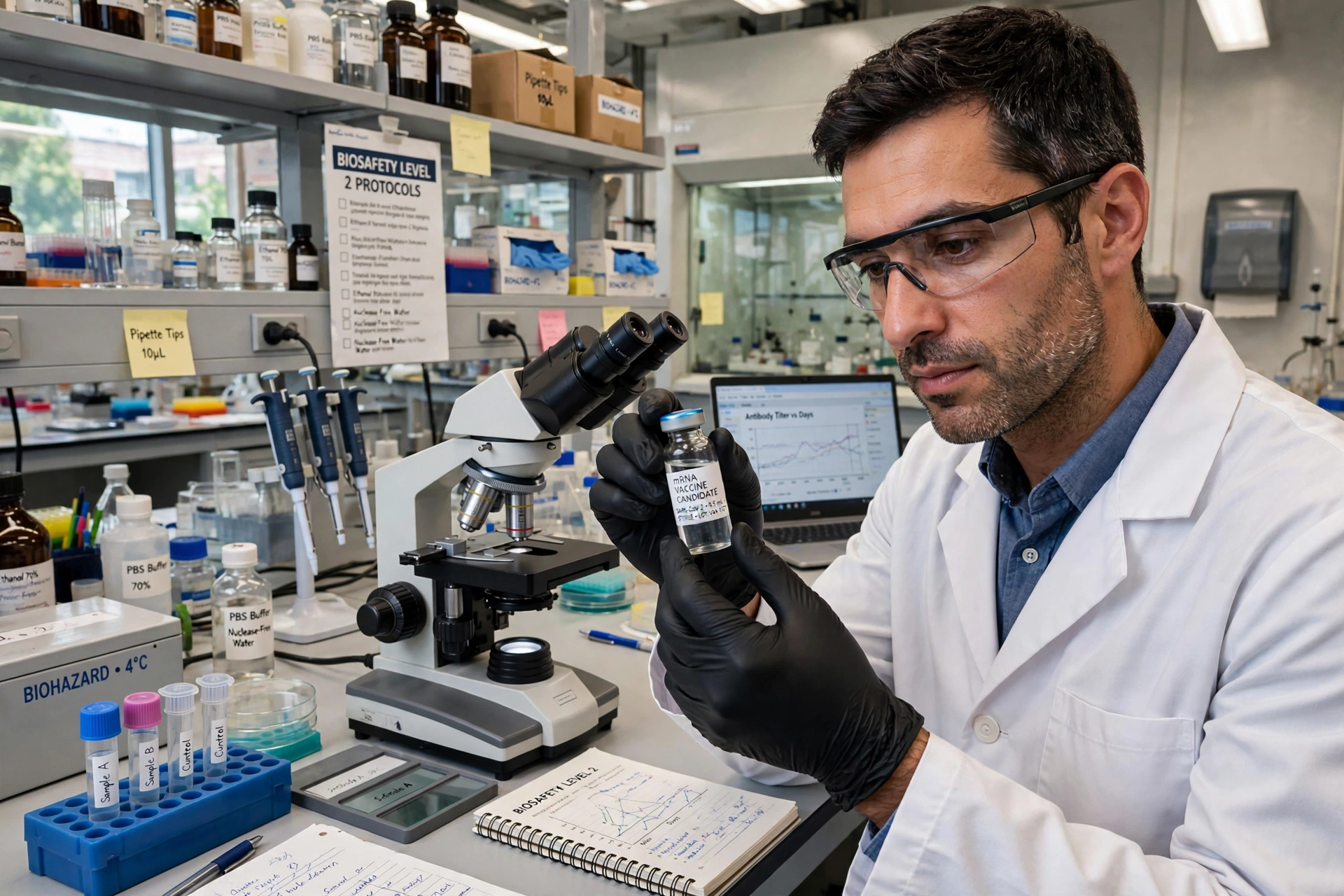
Most medicines are made for millions of people at once. NeoVax is made for exactly one. The personalised neoantigen vaccine, built from the mutations inside each patient’s own tumour, has now been tested with the immunotherapy drug nivolumab in a phase 1 trial for platinum-sensitive recurrent ovarian cancer, with results published in Nature Medicine. Before the excitement runs away with the story, here is the honest headline: this was an early study of feasibility and safety. It showed the vaccines could be made and given, that safety was acceptable, and that immune responses appeared. It did not prove the treatment beats cancer, and no responsible report should claim otherwise.
Recurrent ovarian cancer remains one of the hardest stories in oncology, particularly once disease returns after platinum chemotherapy. Researchers have long wanted a way to point the immune system at targets that exist only on cancer cells. Neoantigens fit that description: they are abnormal protein fragments created by tumour mutations, absent from healthy tissue. A vaccine carrying a patient’s own neoantigens is, in effect, a wanted poster drawn from the tumour itself, designed to teach T cells exactly what to look for.
Building a vaccine with a single name on it
The manufacturing story is half the news. Each vaccine began with sequencing the patient’s tumour, predicting which mutations would produce neoantigens the immune system could recognise, and then producing a bespoke vaccine to order. That pipeline has to work quickly and reliably for people whose cancer has already returned. The trial showed it could be done in practice, with vaccines manufactured and administered to enrolled patients. Reporting in Nature Medicine gives the work credibility, and the journal’s peer review is part of why specialists are taking the feasibility result seriously rather than treating it as a press-release promise.
A partner drug that releases the brakes
Nivolumab, the second element of the trial, is a PD-1 immune checkpoint inhibitor. Some tumours survive by engaging PD-1 to quieten attacking T cells. Blocking that signal can release the brakes on an immune response. Combining it with a vaccine makes conceptual sense: first train more T cells to recognise the tumour, then stop the tumour switching them off. Because both were given together, the study cannot tell us how much each contributed, and it was never sized to answer questions about survival. Our recent coverage of an athlete rebuilding a season match by match has an unlikely echo here: progress in hard fields is usually incremental, and the scoreboard rarely tells the whole story early on.
Reading the results without the hype
What was actually demonstrated? Feasibility, in that personalised vaccines were produced and delivered within a real trial. Acceptable safety, in that the combination was tolerated in this small group at a level researchers judged suitable for further work. And immunological activity, in that T-cell responses against vaccine targets were observed. Those are genuine milestones for a technology that, a decade ago, was largely theoretical. What was not demonstrated is efficacy. There was no large comparison group, no basis for claims about longer life, and no reason for patients to seek this exact combination outside a trial. The National Institutes of Health research ecosystem exists precisely to move ideas through this sequence, from first-in-human caution to properly powered testing.
The long road from phase 1 to standard care
Plenty of promising phase 1 results never become treatments, which is why the next trials matter more than the headlines. Larger studies will need to show whether the immune responses seen here translate into delayed recurrence or other real benefits, which patients benefit most, and whether bespoke manufacturing can scale without losing speed. For now, the fairest summary is a hopeful one with the volume kept sensible: a vaccine built for one patient at a time can be made, can be given safely alongside a checkpoint inhibitor, and can wake up the immune responses it was designed to create. In a field that has heard many big promises, that careful, verified progress is worth reporting exactly as it is.
