
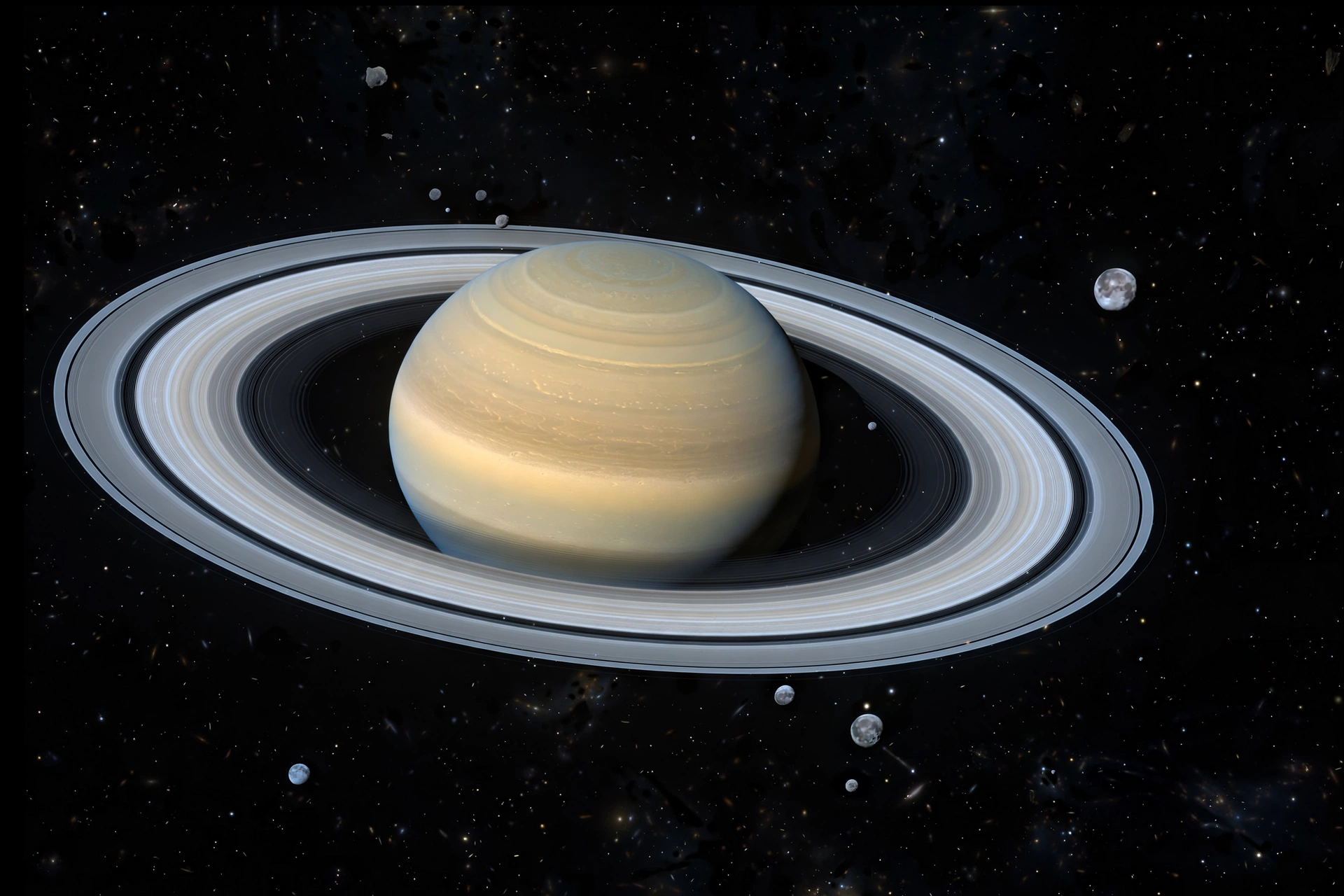
Every great band has members the audience barely notices, working far from the spotlight. Saturn, it turns out, has hundreds of them. Astronomers have confirmed 128 new moons around the ringed planet, raising its total to 274, more than all the other planets in the solar system put together. The previous count stood at 146, so this is not a small update to the roster. It is close to a doubling, announced after years of quiet work by observers who kept watching the faintest performers in the outer dark.
The survey was carried out with the Canada-France-Hawaii Telescope on Mauna Kea in Hawaii, using deep images collected over several years. A team that included University of British Columbia researcher Dr Edward Ashton followed the slow movement of extremely faint points of light, worked out their orbits, and submitted the results for formal recognition. That recognition came from the International Astronomical Union, which maintains the official catalogue. Without that step, a detection remains a rumour; with it, each tiny moon becomes part of the accepted record.
Small moons, strange orbits
Do not picture 128 new versions of our own large, bright Moon. These objects are only a few kilometres across, closer in spirit to rugged asteroids than to the familiar worlds in astronomy posters. They circle Saturn at great distances, on orbits tilted sharply compared with the planet’s equator and its famous rings. Many travel retrograde, moving opposite to Saturn’s spin. That combination, small size, faint reflection, awkward angle and great distance, explains why they escaped notice while larger moons such as Titan have been known for centuries. They were not absent. They were simply far too dim for the techniques astronomers relied on in the past.
How shift and stack found the backing band
The technique behind the discovery is called shift and stack. Observers take many deep exposures, shift each image to compensate for the way a suspected moon should drift, and stack the frames together. Background stars smear away, random noise fades, and a genuine moon, aligned in every frame, stands out clearly enough to track. It rewards patience in the same way a great live recording rewards a careful engineer: nothing about one raw take looks remarkable, but layered together the detail appears. Readers who followed our story on a new streaming drama and its cast will recognise the pattern of a big ensemble hiding smaller names worth knowing. Here the ensemble is a planetary system, and the small names are worlds.
Debris from ancient collisions
Where did so many irregular little moons come from? The leading explanation is violence. Larger moons were probably captured by Saturn’s gravity in the distant past, then broken apart when they collided with other passing bodies. The fragments spread along similar orbits, forming families that astronomers can still identify today because their members share tilts and paths. The University of British Columbia researchers and their colleagues argue that the groupings preserve a record of those impacts. Each family is evidence, written in orbital mechanics, of a smash that happened long before any telescope existed to witness it.
Why the total matters beyond bragging rights
Saturn now leads the moon league by an enormous margin, and Jupiter is not catching up any time soon. But the number itself is the least interesting part. A fuller inventory shows scientists how capture and collision shaped the outer solar system, and how a giant planet collects, breaks and keeps material over billions of years. It also sets a challenge: if 128 moons could hide until now around the most watched ringed planet, other faint populations are surely waiting around its neighbours. The count of 274 will be taught, quoted and printed in textbooks, yet the team behind it would be the first to say the catalogue is a work in progress. Saturn’s backing band is bigger than anyone thought, and some members may still be waiting for their first credit.
